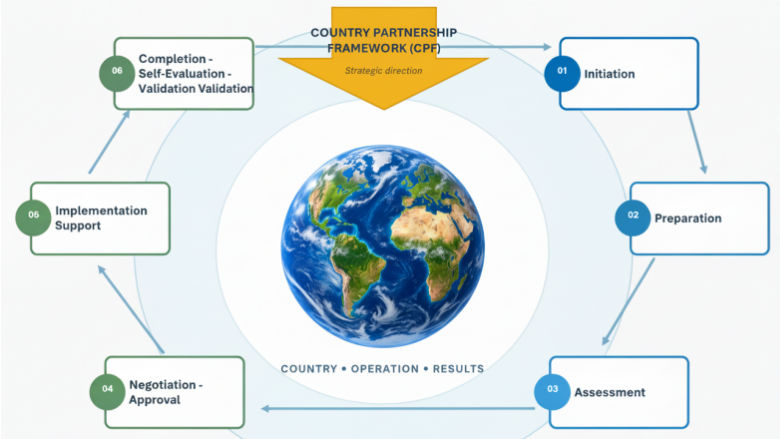
The project operation cycle is the framework used by the World Bank (‘the Bank’) to initiate, prepare, assess, provide implementation support to, and carry out self-evaluation of operations. The Bank and the Borrower work closely throughout the operation cycle, although they have different roles and responsibilities.
The World Bank operation cycle includes six stages:
- Initiation
- Preparation
- Assessment
- Negotiation/approval
- Implementation and supervision
- Completion/validation and evaluation
Below is an outline of the six stages, the key documents produced during the various stages, and links to access them.
In 2026, the Bank introduced a new unified operating model for all lending instruments. It aims at faster approvals, delegated decision making, and reduced preparation time and shifts to risk-based processing to reduce friction and focus oversight where it matters most. It integrates the Knowledge Bank into operations.
1. Initiation
The task of identifying and proposing operations for World Bank financing lies mainly with the Borrower. The design of operations is guided by the Country Partnership Framework (CPF), which together with the Systematic Country Diagnostic (SCD), outlines the country development priorities and provides the strategic framework for World Bank Group support. For further information, click on the WBG Directive and Guidance.
Once an operation is identified, the Borrower and the Bank agree on an initial design and the Bank's team outlines the basic elements in a Project/Program Paper. The Prioject/Program Paper identifies proposed parameters, objectives, risks to these objectives’ achievement, expected results, possible level of financing, alternative scenarios, and a likely timetable for the preparation process. Two Bank documents are prepared and disclosed to the public during this phase. The Project/Program Information Document (PID) which outlines the scope of the intended operation and the Environmental and Social Review Summary (ESRS) for investment projects starting in October 2018 that apply the Environmental and Social Framework (ESF). For investment projects under the previous Safeguard Policies, an Integrated Safeguards Data Sheet is made available to the public. The transition from the Safeguard Policies to the ESF will take several years, as operations approved under the Safeguard Policies continue to apply those policies through the end of the operation cycle. Development Policy Financing (DPF) operations do not require an ESRS on Environmental and Social Systems Assessment (ESSA), instead, the environmental and social effects of the supported policies are assessed as part of the Program Document.
- Project/Program Information Document
- Environmental and Social Review Summary
- Integrated Safeguards Data Sheet
2. Preparation
The Borrower is responsible for the preparation phase, which for investment project financing (IPF) includes conducting technical, economic, social and environmental assessments and preparing feasibility studies, engineering and technical designs, among others. Most Borrowers typically contract with consultants and private sector firms for goods, works and services, as needed, during this phase and later during the operation's implementation phase. For Program-for-Results financing (PforR), preparation focuses on assessing the Borrower's own program and systems, including an ESSA. For DPFs, the Borrower plays a central role in designing the reform program, which defines the policy and institutional actions supported by the operation. Across all operation types, the Borrower and the Bank team also give attention to other important concerns including citizen engagement, gender, climate change, private capital facilitation, fraud and corruption, and grievance redress mechanisms. Beneficiaries and stakeholders are also consulted during this phase to ensure the operation considers their needs.
In addition to providing financing, the World Bank serves as a vehicle for global knowledge transfer and technical assistance and generally takes an advisory role and offers analysis and advice during this phase. The Bank team supports the Borrower in developing the operation design, identifying implementation arrangements, and conducting various reviews and studies. The Bank assesses the relevant capacity of the implementing agencies at this point to reach agreement with the Borrower on arrangements for overall operation management, such as the systems required for financial management, procurement, environmental and social risk management, reporting, and monitoring and evaluation. For DPF operations, at this stage the World Bank team also focuses on assessing the Borrower's macroeconomic framework and the strength and ambition of the supported reform program.
Earlier screening by Bank staff may have determined that a proposed operation could have potential adverse environmental or social impacts. For new IPF projects, the Bank currently applies the ESF. The ESF sets out the World Bank’s commitment to sustainable development through a Bank Policy and a set of Environmental and Social Standards that are designed to support Borrowers to better manage environmental and social (E&S) risks. It uses an up-to-date and risk-based approach, addresses a wider range of environmental and social risks and potential impacts and better integrates the Bank’s Environmental and Social policies. The ESF clearly defines the role of the World Bank versus the Borrower, whereby the Bank applies due diligence to the operation under the Environmental and Social Policy (ESP) and the Borrower follows the requirements of the ten Environmental and Social Standards (ESS1-10). DPF and PforR operations do not apply the ESF; instead, they have their own provisions for environmental and social risk management. For DPF, the environmental and social effoects of the supported policies are assessed as part of the preparation process. For PforR, environmetal and social risks are addressed through the ESSA, which evaluates the adequacy of the Borrower's own system.
3. Assessment
Assessment gives the Borrower an opportunity to review the operation design in detail and resolve any outstanding questions. The Borrower and the Bank review the work done during the initiation and preparation phases and confirm the expected operation outcomes, intended beneficiaries, application of ESF requirements (for IPF) and tools for monitoring progress. Agreement is reached on the viability of all aspects of the project at this time. The Bank team confirms that all aspects of the operation are consistent with all World Bank operations requirements, assesses the operation's technical design and readiness for implementation, and that the Borrower has institutional arrangements in place to implement the operation efficiently. All parties agree on an operation timetable and on public disclosure of key documents and identify any unfinished business required for final Bank approval. The PID and the ESSR (for IPF) are updated and disclosed during this phase.
4. Negotiation/Approval
Once all operation details are negotiated and accepted by the Borrower and the Bank, the Bank team finalizes the Project Paper (for IPF), the Program Paper (for PforR) or the Program Document (for DPF), along with other financial and legal documents, for submission to the Bank's Board of Executive Directors for consideration and approval.
5. Implementation Support
Operation implementation is the responsibility of the Borrower, while the Bank’s role is to provide effective implementation support to improve results, help manage risks, and increase institutional development. With technical assistance and support from the Bank, the Borrower prepares the specifications for the operation and carries out all procurement of goods, works and services needed, as well as any environmental and social impact mitigation set out in agreed plans, including those described in the Environmental and Social Commitment Plan (ESCP). Financial management and procurement specialists on the Bank's team ensure that adequate fiduciary controls on the use of operation funds are in place. For PforRs, Disbursement-Linked Indicators (DLIs), and implementation support focuses on the Borrower's proram performance and systems. For DPFs, implementation involves monitoring the Borrower's progress on the agreed reform program and policy measures. Across all instrument types, changing circumstances, operation delays and unexpected events can sometimes require adjustments to the operation design, such as implementation arrangements or even objectives, resulting in a restructuring.
The implementing agency reports regularly on operation progress and results. The Borrower and the Bank also join forces at least twice a year to prepare a review of operation progress. Based on this review, the Bank team prepares an Implementation Status and Results Report.
6. Completion/Self-Evaluation
When an operation is completed and closed at the end of the loan disbursement period, the World Bank, with input from the Borrower and other stakeholders, compiletes, a self evaluation, which evaluates the operation's outcomes; challenges, and lessons learned to determine what additional measures are needed to sustain the benefits derived from the operation. In addition, the evaluation team assesses how well the entire operation complied with the Bank's operations policies and accounts for the use of Bank resources.
Validation and Evaluation
The Independent Evaluation Group (IEG) evaluates the development effectiveness of the World Bank Group. IEG is independent of the Management of the World Bank Group and reports directly to the Executive Board. IEG conducts different types of evaluation, validation, and synthesis exercises. At the operation cycle level, IEG validates 100% of the self-evaluations that WB operational teams conduct upon operation completion. In addition, IEG conducts strategically selected operation-level Cluster evaluations, which analyze patterns across a selection of similar closed operations with the aim of providing concrete, operational lessons on a narrow set of interventions around specific topics. Learn more about how evaluation is conducted at the World Bank by reviewing the World Bank Group Evaluation Principles.
Some project and bidding documents are made available to the public.